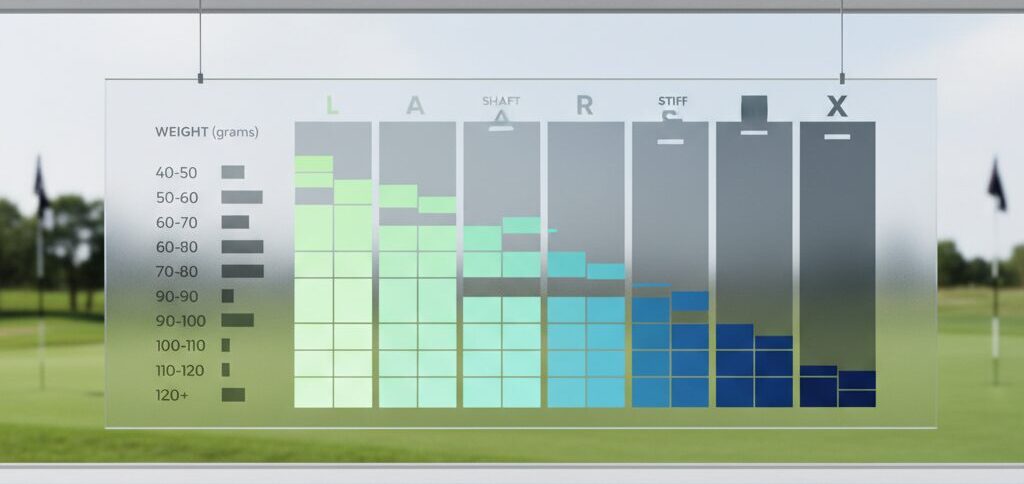
Golf shaft weight is one of the most overlooked factors in club fitting, yet it has a direct impact on swing speed, distance, and shot consistency. A golf shaft weight chart helps golfers match the correct shaft weight to their swing profile, making it easier to optimize performance without trial and error.
This guide breaks down shaft weight categories, what they mean for different player types, and how to use a weight chart to make smarter equipment decisions.
Quick Answer
Golf shaft weights typically range from 40g to 130g, divided into categories for drivers, irons, and wedges. Lighter shafts (40–65g) suit slower swing speeds, while heavier shafts (70–130g) benefit faster, more aggressive swingers. Matching shaft weight to your swing speed improves control, consistency, and overall ball-striking performance.
Key Takeaways
- Shaft weight ranges from approximately 40g (ultralight) to 130g (heavy) depending on club type
- Lighter shafts generally help golfers with slower swing speeds generate more clubhead speed
- Heavier shafts offer more control and stability for players with faster, more aggressive swings
- Driver shafts are typically lighter than iron or wedge shafts
- Shaft weight affects tempo, feel, and shot shape just distance
- Getting fitted by a professional is the most reliable way to confirm right shaft weight for your game
Golf Shaft Weight Chart by Category
The following chart covers the standard weight ranges used across driver, iron, and wedge shafts.
| Club Type | Ultralight | Light | Mid-Weight | Heavy |
|---|---|---|---|---|
| ドライバー | 40–50g | 50–60g | 60–70g | 70g+ |
| Fairway Wood | 50–60g | 60–70g | 70–80g | 80g+ |
| Hybrid | 60–70g | 70–80g | 80–90g | 90g+ |
| アイアンズ | 65–75g | 75–90g | 90–105g | 105–130g |
| ウェッジソール | 90–100g | 100–110g | 110–120g | 120– |
These ranges reflect standard industry benchmarks. Individual manufacturers may vary slightly, but this chart provides a reliable reference point for most golfers.
What Shaft Weight Should You Use?
Matching Shaft Weight to Swing Speed
The most practical way to choose shaft weight is to start with your driver swing speed. Here is a general guideline:
- Under 70 mph: Ultralight shafts (40–55g) help maximize clubhead speed
- 70–85 mph: Light shafts (55–65g) offer a balance of speed and control
- **85– shafts (65–80g) suit the majority of recreational golfers
- 100–110 mph: Heavier shafts (80–95g) provide stability and reduce unwanted spin
- 110+ mph: Tour-weight shafts (95g+) are built to handle elite swing speeds
Does Heavier Always Mean More Control?
Not necessarily. A shaft too heavy can slow down your swing, reducing both distance and accuracy. The goal is to find the heaviest shaft you can swing comfortably without losing speed or tempo.
Conversely, a shaft that is too light can feel uncontrollable and promote inconsistent contact. Balance key factor, not simply going heavier or lighter.
How Shaft Weight Affects Your Game
Swing Tempo and Feel
Shaft weight influences how the club feels throughout the swing. Heavier shafts tend to suit golfers with a smooth, deliber. Lighter shafts respond well to quicker, more aggressive transitions.
If you feel like your club is “getting away from you” at the top of your backswing, a slightly heavier shaft might help you maintain better sequencing. Angle and Spin
Lighter shafts tend to produce higher launch angles and more spin, which can benefit slower swingers who struggle to get the ball airborne. Heavier shafts generally lower spin rates and launch, which helps fasterwingers keep the ball flight more penetrating and controlled.
Understanding ゴルフスピン率 is useful here, because shaft weight is one of several variables that influence how muchkspin and sidespin your shots generate.
Iron vs. Driver Shaft Weight
It is normal and expected for your iron shafts to be significantly heavier than your driver shaft. Many golfers play a 60g driver shaft alongside 100–120g steel iron shafts without any issue. The two are independent systems and do not need to match.
If you are exploring different types of golf irons or considering a full set upgrade, shaft weight should be evaluated separately for each club category.
Common Misconceptions About Shaft Weight
Myth: Heavier shafts are always better for accuracy.
Reality: Accuracy depends on matching weight to your swing, not simply adding weight. shafts are only for beginners or seniors.**
Reality: Many skilled players with, compact swings perform better with lighter shafts.
Myth: You shaft weight by how the club feels at address.
Reality: Shaft weight is best evaluated during full swing, not when standing still.
Should You Get a Shaft Fitting?
A professional shaft fitting removes the guesswork from this process. A certified fitter will measure your swing speed, tempo, attack angle, and ball flight to recommend the optimal shaft weight across your entire bag.
If a full fitting is not immediately accessible, using the swing speed guidelines above alongside the shaft weight chart gives you a solid starting point for narrowing your options.
Tools like golf rangefinders and launch monitors used during fittings can also help track how different shaft weights affect your distances and dispersion patterns on the course.
結論
Shaft weight is a fundamental variable in equipment performance that deserves the same attention as loft, flex, or clubhead design. Using a golf shaft weight chart as a reference point helps you align your equipment with your swing speed, tempo, and physical profile.
Whether you are building a new set or evaluating an existing one, understanding shaft weight categories puts you in a better position to make informed decisions and play more consistent golf.
よくあるご質問
What is the standard shaft weight for a driver?
Most recreational golfers use driver shafts in the 55–75g range. Tour players often use shafts in the 65–80g range, while seniors and slower swingers typically benefit from shafts in the 45–60g range.
Is a heavier shaft better for accuracy?
Not automatically. A heavier shaft improves accuracy only when it matches your swing speed and tempo. Using a shaft that is too heavy can actually reduce both distance and consistency.
What shaft weight do most amateur golfers use?
The majority of male amateur golfers use iron 85g and 105g and driver shafts between 55g and 70g. Women’s shafts tend to fall in the 40–65g range across most club types.
Can the wrong shaft weight cause a slice or hook?
Yes. A shaft that is too light can cause the clubface to close aggressively, promoting hooks. A shaft that is too heavy may cause the face to lag open, leading to sl pushes.
How much does shaft weight affect distance?
Research and data suggest that using the correct shaft weight can add 5 to 15 yards for golfers who are currently mismatched. The gain comes from improved swing speed, better contact, and optimized launch conditions.
This article was last updated on 4月 14, 2026 .




 Japanese
  English
  German
  Portuguese